How Much Does a Full Set of American Football Kit Actually Cost for Beginners?
American football is captivating more and more Europeans. With the NFL’s expansion into France, the success of matches played in Paris, and the rise of French amateur leagues, an increasing number of players are keen to give it a go. But before stepping onto the pitch, one question immediately springs to mind:How much do you need to invest to get the right equipment?
Unlike basketball or traditional football, American football is a contact sport that requires players to wear full protective kit. And it is precisely this kit that makes the difference between playing safely and risking serious injury. This point should not be underestimated: an unsuitable helmet or poor-quality shoulder pads simply do not provide adequate protection.
In this guide, we explain in detail every piece of equipment, its role, the best brands, and what to expect across three budget levels:small budget, mid-range and high-end. Plus, there’s a section dedicated to training and match balls.
A Football Player’s Full Kit
Before we talk about prices, here is a comprehensive list of what an American football player needs to wear on the pitch:
Compulsory protective equipment:
- Helmet
- Shoulder pads
- Cup protector
- Knee pads
- Thigh pads
- Hip pads
- Tailbone pad
- Mouthguard
Clothing:
- Jersey
- Football trousers (football pants)
- Compression underwear (girdle)
- High-top socks
Shoes:
- American football studs
Accessories:
- Catcher’s / lineman’s gloves
- Sports tape
- Equipment bag
It’s much more than just basketball or baseball kit. And every piece is important. Let’s take a look at them.
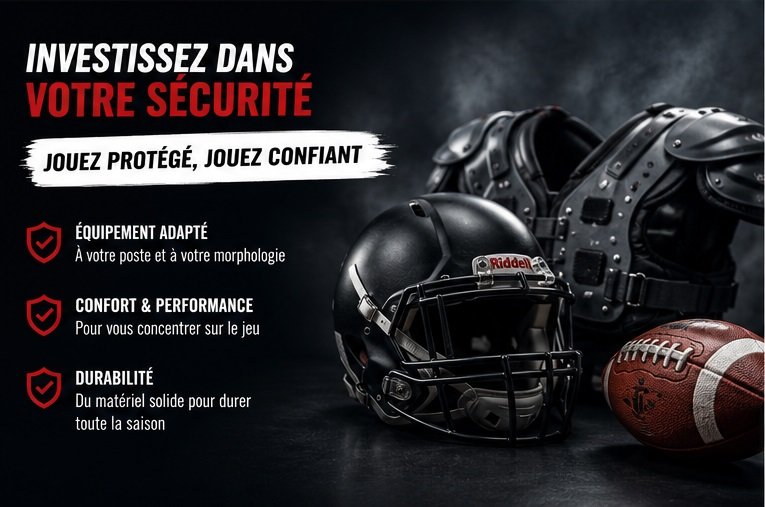
1. The American Football Helmet: The Most Critical Piece of Kit
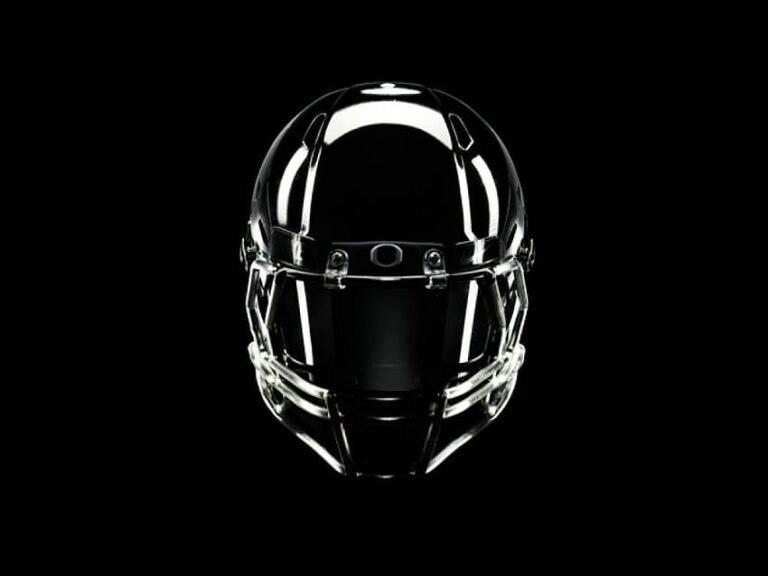
The helmet is undoubtedly the largest investment all the kit. It is this that protects your brain from concussions — a very serious issue in American football, which has led to decades of research and technological development.
Never compromise on the quality of your helmet. A low-end helmet bought second-hand without a recent certification can be dangerous. Helmets are subject to NOCSAE (National Operating Committee on Standards for Athletic Equipment) certification, which attests to their level of protection.
Leading helmet brands
Riddell is a legendary American football brand. As the NFL’s official equipment supplier for decades, Riddell produces helmets for all levels, from beginners to professionals. Their SPEEDFLEX, AXIOM and SPEEDFLEX PRECISION ranges are the gold standard in the sport.
Schutt Sports is Riddell’s main rival. Recognisable by its often more angular shells and its TPU Cushioning technology (thermoplastic pads), Schutt supplies equipment to numerous university and professional teams. Its F7, Vengeance and ION ranges are very popular.
Vicis is the industry’s revolutionary newcomer. Founded by engineers and doctors, the Seattle-based brand has developed a radically different technology: an outer shell flexible(RFLX Technology), which absorbs multi-directional impacts far more effectively than a traditional rigid shell. Vicis helmets have consistently topped the NFL’s safety rankings. The Zero2 Matrix range is their current flagship product.
Xenith is another innovative brand that has revolutionised the internal cushioning system with its Adaptive Fit cushioning system — air bubbles that automatically adapt to the shape of the skull upon impact. The Shadow and Epic ranges are very popular amongst university players and in Europe.
Prices by level
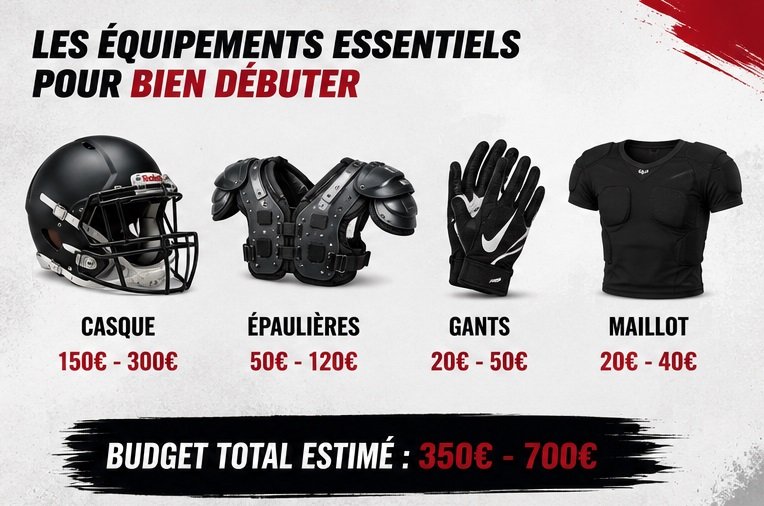
Low budget (€80–150) At this price point, you can find entry-level helmets from Riddell (Speed Icon range) or Schutt (Recruit range). They meet the basic certification standards and offer adequate protection for beginners. The internal padding system is often made of simple foam, which is less effective than an adaptive cushioning system. It’s acceptable for your first set of kit in a beginner’s amateur league, but should be replaced as soon as you start playing regularly.
Mid-range (€150–300) The go-to choice for the vast majority of serious amateur players. This category includes the Riddell SPEEDFLEX, Schutt F7 and Xenith Shadow ranges. The padding system is far more sophisticated, ventilation is better, and protection is significantly superior. The adjustment system (pump fit or rear lacing) allows for a precise fit tailored to the player’s body shape. This is the recommended level for any regular club play.
High-end (€300–600 and above) Premium helmets represent the very best that the science of head protection has to offer. The Vicis Zero2 Matrix(~€400–500) and the Riddell AXIOM(~€400–550) top the global safety rankings. The Xenith Epic+(~€300–400) and the Schutt F7 LX round off this list. These helmets incorporate multi-layered technologies, systems to manage rotational impacts (often linked to concussions), and ultra-strong composite materials. For players involved in serious competition, this is an investment that is fully justified in terms of long-term safety.
💡Important advice: American football helmets must be recertified or replaced every 10 years in accordance with NOCSAE standards. Be wary of second-hand helmets without up-to-date certification — protection may be seriously compromised even if they look fine on the outside.
Discover our selection of American football helmets on Sportland American.
2. Shoulder Pads: Protection and Mobility
Shoulder pads are the second key piece of kit. They protect the shoulders, collarbone, breastbone and upper back during contact. But be aware: they are not all the same, depending on the position you play.
Shoulder pads depending on the position
- Skill positions(quarterback, receiver, running back, cornerback): lighter, more compact shoulder pads, designed to prioritise mobility and arm range of motion
- Linemen(offensive and defensive line): wide, heavily padded shoulder pads, designed for repeated and intense head-on contact
- Linebacker / Safety: mid-range models combining protection and mobility
Prices by level
Small budget (€50–100) Functional shoulder pads made from ABS plastic with basic EVA foam padding. Suitable for beginners looking to get to grips with the sport. Mobility may be slightly limited and durability may be lower.
Mid-range (€100–200) Brands such as Riddell, Schutt, Douglas and Rawlings offer shoulder pads in this range featuring high-density polyethylene shells, multi-density foam padding and adjustable fastening systems. Mobility is much better and the protection is significantly more effective.
High-end (€200–400) Premium shoulder pads use composite materials (carbon fibre, Kevlar) to achieve an optimal balance between weight and protection. Some feature adaptive padding systems or additional removable protective plates. They are essential for linemen in serious competition.
3. Body Protection: The Complete Pack
As well as helmets and shoulder pads, American football requires a range of protective gear that is generally incorporated into the football shorts or in a compression underwear (girdle).
These safeguards include:
- Thigh guards(thigh pads): inserted into pockets in the trousers
- Knee pads(knee pads): same system
- Hip protectors(hip pads): built into the girdle or trousers
- Coccyx protector(tailbone pad): lower back support, often incorporated into a girdle
- Shell(cup): compulsory, built into the underwear
Prices by level
Complete budget protection pack (€30–60) Basic girdle and pad sets sold as a kit. The foam is simple but adequate for beginners. Some American football trousers already include the pockets and, in some cases, the basic pads.
Mid-range (€60–120) Girdles from brands such as McDavid, Douglas and Gear Pro-Tec, featuring multi-density foam or gel pads. They offer significantly greater comfort and more consistent protection.
High-end (€120–250) Protective systems featuring D3O pads (a viscoelastic material that hardens on impact) or composite materials. Extremely lightweight and highly protective, worn by NFL players.
4. The Jersey and Trousers: Regulation and Technical Kit
The Jersey
The American football jersey is distinguished by its very loose fit(to slip over the shoulder pads) and its fabric, which is highly resistant to snagging. At club level, it is usually provided or purchased in the team’s colours.
Low budget (€25–45): generic jerseys made from durable polyester.Mid-range (€45–90): technical tops from Nike, adidas or Under Armour with moisture-wicking properties.High-end (€90–200): authentic NFL replicas or bespoke shirts in the club’s colours.
Football Trousers (Football Pants)
The trousers feature pockets for thigh and knee pads. They must be strong enough to withstand contact with the ground.
Low budget (€20–40): basic trousers with built-in pockets.Mid-range (€40–80): anatomical fit, durable stretch fabrics, well-placed pockets.High-end (€80–150): top-of-the-range compression fabrics, maximum lightness, used in competition.
5. American Football Cleats
American football studs are different from those used in traditional football. They are designed for specific playing surfaces (natural grass, artificial turf) and provide greater ankle support.
A distinction is made between:
- High-top trainers(high-top): maximum ankle support, popular with linemen and players in the front row
- Mid-cut studs(mid-top): balance between flexibility and support, versatile
- Low-cut studs(low-top): maximum lightness and speed, a firm favourite with receivers and full-backs
Prices by level
Low budget (€40–70) Entry-level football boots from Nike, adidas or Under Armour. Comfortable and practical for beginners.
Mid-range (€70–130) The Nike Alpha Menace, adidas Freak and Under Armour Spotlight ranges offer excellent support, partial carbon fibre soles and good grip.
High-end (€130–250) The Nike Vapor Edge Elite, adidas Freak Ultra and Under Armour Highlight Elite are football boots worn in NCAA and NFL competitions. Extremely lightweight, with a carbon plate and premium support.
6. American Football Gloves
Gloves are optional depending on the position, but are very common. These include:
- Catcher’s gloves: maximum grip for catching the ball, slender fingers and tactile sensitivity
- Lineman’s gloves: enhanced protection for fingers and knuckles, padded palm
- Quarterback gloves: often half-fingered or no gloves at all, to maintain the feel of the ball
Low budget (€15–30): basic gloves with decent grip.Mid-range (€30–60): Nike Superbad, adidas Freak, Under Armour F8 — models featuring GlueGrip or Stickum technology.High-end (€60–120): advanced grip technologies, ultra-stretch Lycra fabrics, used in the NFL.
7. The Mouthguard: Small Budget, Big Impact
Although often overlooked, the mouthguard is nevertheless compulsory in American football and plays a real role in preventing concussions (by absorbing some of the impact to the jaw). There are two types:
- Thermoformable mouthguard(€5–15): to be moulded by hand in hot water, very common
- Custom-made mouthguards(€50–150): fitted by a dentist, for optimum comfort and protection
8. American Footballs: Training and Matches
The American football is a piece of kit in its own right, whether for individual training, team sessions or official matches.
The different sizes
| Size | Surname | Target audience |
|---|---|---|
| Size 6 | Pee Wee | Children up to the age of 9 |
| Size 7 | Junior | Ages 10–12 |
| Size 8 | Youth | Ages 12–14 |
| Size 9 | Intermediate | Ages 14–16 |
| Size 9 (official) | Official | Adults, competition |
As with basketball, playing with a ball that is unsuitable for a child’s physique hinders the development of proper technique. A 10-year-old child trying to throw an official-size ball will inevitably develop poor grip habits.
Leading balloon brands
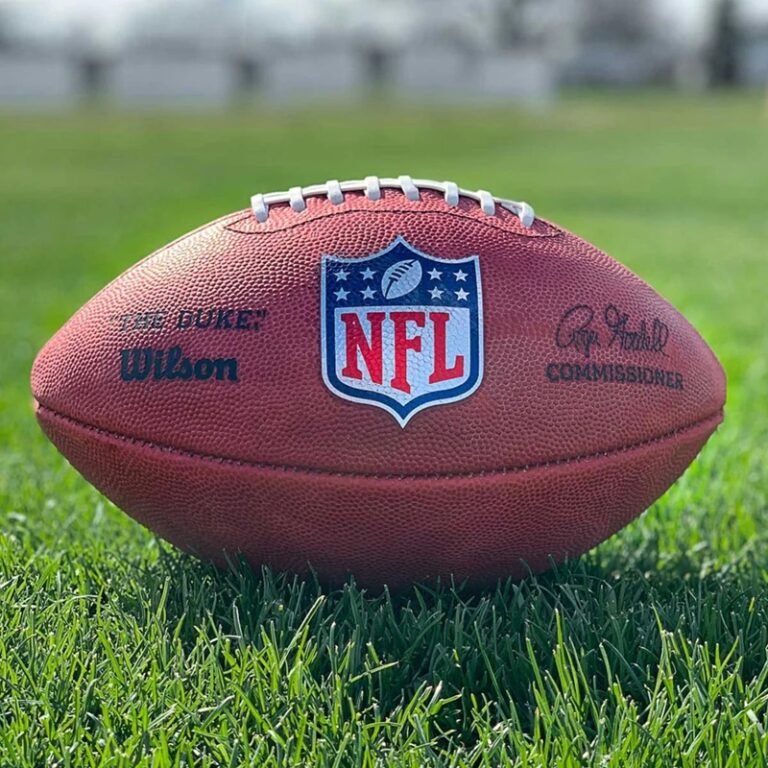
Wilson has been the official NFL equipment supplier for decades. The Wilson “The Duke” is the official match ball for the NFL. Wilson offers ranges to suit all levels and sizes.
Spalding is also a long-established name in American footballs, with an extensive range catering for everyone from beginners to competitive players.
Franklin Sports and Baden offer very affordable entry-level balls, perfect for children and beginners.
Riddell It also produces footballs, particularly for young players at various stages of their development.
Training balls vs match balls
Training ball: composite leather or reinforced rubber, designed to withstand heavy daily use. The grip surface is often slightly thicker than that of a match ball, but it offers superior durability. Ideal for throwing sessions, snap drills and team training sessions.
Match ball: genuine leather (for the official ranges) or premium composite leather. The surface texture is optimised for grip during passes and receptions. The bounce is more precise and the shape is perfectly calibrated.
Discover our selection of American footballs on Sportland American.
Prices by level
Low budget (€20–40) Basic rubber or composite balls from brands such as Franklin or Baden. Ideal for beginners, for playing outdoors and for withstanding training sessions without the risk of damaging an expensive ball.
Mid-range (€40–80) The Wilson GST, Spalding J5V and Riddell Youth ranges all feature high-quality composite leather, excellent grip and a feel similar to that of match balls. The go-to choice for regular club play.
High-end (€80–160) The Wilson "The Duke" Replica or the Wilson GST Official are the gold standard in footballs. The genuine leather, the precise pebble-grain texture and the official size make them the balls of choice for serious competition and the NFL. For quarterbacks working on their throwing mechanics, the feel of a premium ball makes a real difference.
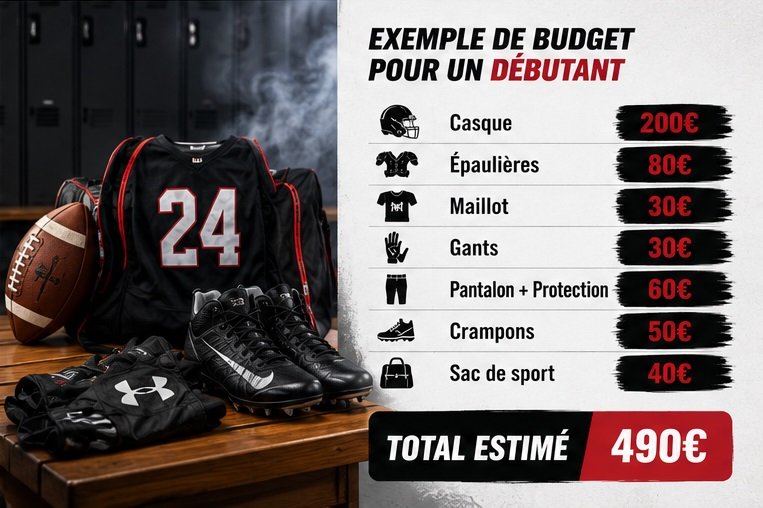
Total Budget: Summary by Level
Small Budget — The Essentials to Get You Started
| Job | Estimated price |
|---|---|
| Helmet (certified entry-level) | €90–140 |
| Shoulder pads | €50–90 |
| Body protection pack (girdle + pads) | €35–60 |
| Jersey | €25–40 |
| Football shorts | €20–35 |
| Crampons | €40–65 |
| Mouthguard | €5–10 |
| Ball (suitable size) | €20–35 |
| TOTAL | €285–475 |
Ideal for: trying out the sport, getting started at an amateur club, or kitting out a child starting out.
Mid-range — The go-to choice for regular players
| Job | Estimated price |
|---|---|
| Helmet (Riddell SPEEDFLEX / Xenith Shadow) | €180–280 |
| Shoulder pads | €110–180 |
| Personal Protective Equipment Pack | €70–110 |
| Technical jersey | €50–80 |
| Football shorts | €45–70 |
| Football boots (Nike Alpha / adidas Freak) | €80–120 |
| Catcher’s/lineman’s gloves | €35–55 |
| Mouthguard | €10–20 |
| Wilson GST Ball | €50–70 |
| Equipment bag | €40–65 |
| TOTAL | €670 – €1,050 |
Ideal for: club players who train regularly, amateur competitions, and teenagers who are members of a club.
Top of the Range — Equipment for Competitors
| Job | Estimated price |
|---|---|
| Helmet (Vicis Zero2 Matrix / Riddell AXIOM) | €380–550 |
| Carbon/composite shoulder pads | €220–380 |
| Premium D3O Protective Kit | €140–230 |
| Competition jersey | €90–180 |
| Top-of-the-range compression trousers | €85–140 |
| Football boots (Nike Vapor Edge Elite) | €140–220 |
| Premium gloves (Nike Superbad / UA F8) | €60–110 |
| Custom-made mouthguards | €60–130 |
| Wilson ‘The Duke’ Ball / GST Official | €90–150 |
| Large-capacity kit bag | €70–120 |
| TOTAL | €1,335 – €2,210 |
Ideal for: players competing at national level, players looking for the best possible protection, and enthusiasts who want the best long-term equipment.
Children vs Adults: What You Need to Know
Youth American football (including flag football) is growing very rapidly in France. For parents, here are the key points:
Flag football first: for children under 10–12 years old, many clubs offer flag football(no contact; a flag attached to the belt is pulled out). In this case, full protective kit is not required: a simple shirt, shorts and studded boots are sufficient. Budget flag:€50–100.
The size of the ball is crucial: An 8-year-old child should play with a Pee Wee ball (size 6). A ball that is too big prevents the correct development of throwing technique.
The helmet comes first: If your child plays contact football, don’t skimp on the helmet. It’s the piece of kit that protects their brain. A good, NOCSAE-certified helmet costing €130–150 is better than a low-end or second-hand, uncertified helmet.
Growth: Just like in basketball, children grow quickly. Set aside a budget to replace protective gear every 1 to 2 years, depending on how much they grow.
Our Final Recommendations
American football is clearly the sport that costs the most in terms of equipment among American sports. But this investment is justified by the physical nature of the sport: protective gear is not just an accessory; it is essential safety equipment.
For an adult beginner: Expect to pay between €300 and €500 for decent kit that will allow you to ride safely. Never skimp on a helmet just to save money.
For a child taking part in a contact sport: between €300 and €450, opting for a good-quality, certified helmet and shoulder pads suited to your body shape.
For a regular competitive player: The mid-range option, costing between €700 and €900, strikes the right balance. A Riddell SPEEDFLEX or a Xenith Shadow, paired with a sturdy set of shoulder pads, will last you several seasons.
For top-level sport: The Vicis and Riddell AXIOM brands top the safety rankings. If you play at a high level, investing in a premium helmet is as much a decision about your health as it is about your performance.
Discover our full range of equipment for American football on Sportland American— helmets, shoulder pads, balls and protective gear for all levels.
Next article in the series: How much does a full set of kit really cost for a beginner in baseball?
Article written by the Sportland Europe team – Your specialist in American sports.Women’s American football clubs in France, Sportland American partnership club
🇬🇧 Version : English | 🇫🇷 Version française