🏒 How to choose the right hockey stick: the complete guide 2025
Introduction
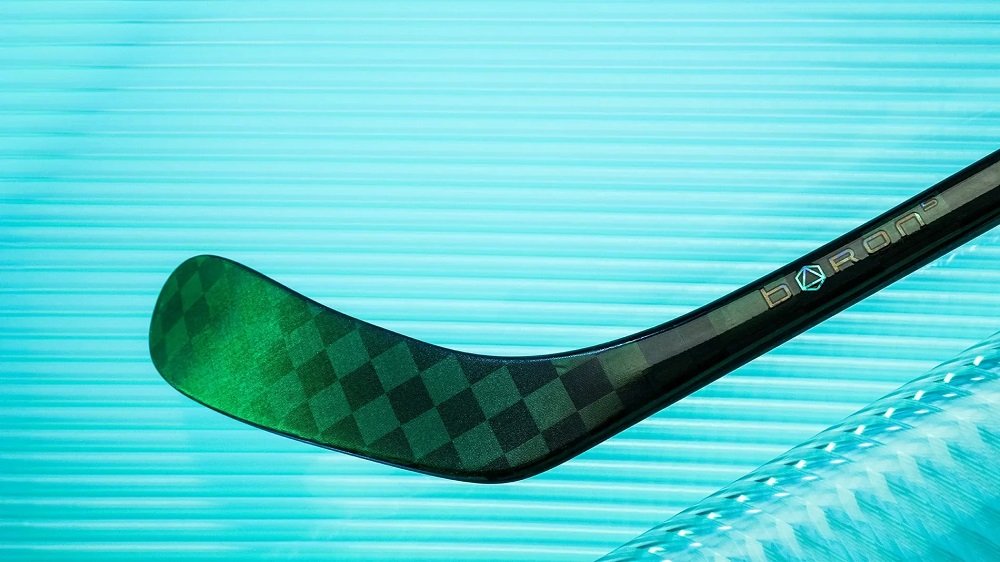
Choose your hockey stick is not a task to be taken lightly. Whether you play on ice, rollerblades or inline, your stick has a direct influence on your shooting power, accuracy and puck control. Between the flex the curvature the length and materials Every detail counts.
This guide explains how to choose the right hockey stick depending on your style of play, your size and your level - to shoot harder, aim sharper and play more comfortably. Find all the sticks available on our website sportlandamerican.com
🧍♂️ 1. Length: a basic criterion often overlooked
Before talking about technique, we need to make sure that the stock length is adapted to your body shape.
- Stock too long : your puck control decreases, you lose manoeuvrability.
- Stock too short : you gain in agility, but lose in shooting power.
💡Simple method: without skates, the stock must arrive between the chin and nose. With skates, it must reach the chin level.
Offensive players often prefer a slightly shorter stick for better dribbling, while defenders opt for a longer stick for better reach.
💪 2. The flex: the power of the shot
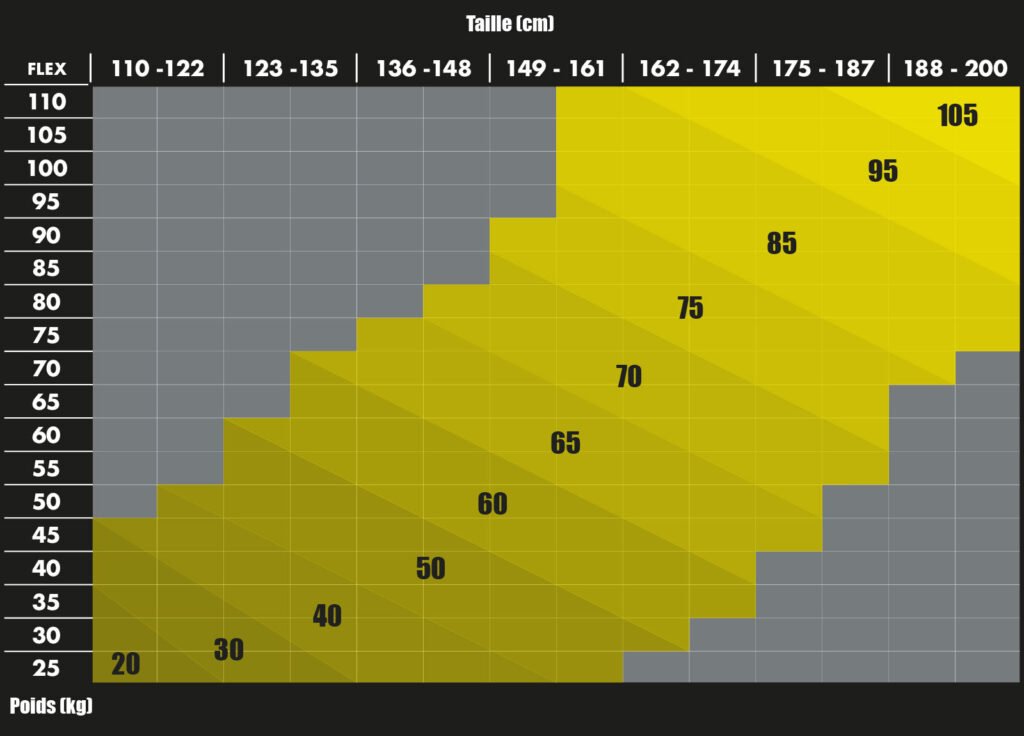
Le flex corresponds to the flexibility of the handle In other words, the ability of the stock to bend when the shot is fired.
It is expressed as a number (e.g. 65, 75, 85, 95), which indicates the force required to bend the stock by one inch(2.54 cm).
🧾 How do you choose the right flex?
A simple rule:
The ideal flex is half your weight in pounds.
Example: a 160 lb (≈72 kg) player would choose a flex of 80.
🧨 Differences according to style of play
- Low flex (65-75) Ideal for young, light players or those looking for a quick wrist shot (snaps, wrist shots).
- Medium flex (80-87) Balance between power and control, perfect for most intermediate players.
- High Flex (90-100+) Reserved for powerful players or defenders who rely on slapshots.
💡Tip: if you shorten your stick, rigidity increases. Think about lower your flex slightly if you cut your handle.
🌀 3. Bends: precision, lift and control
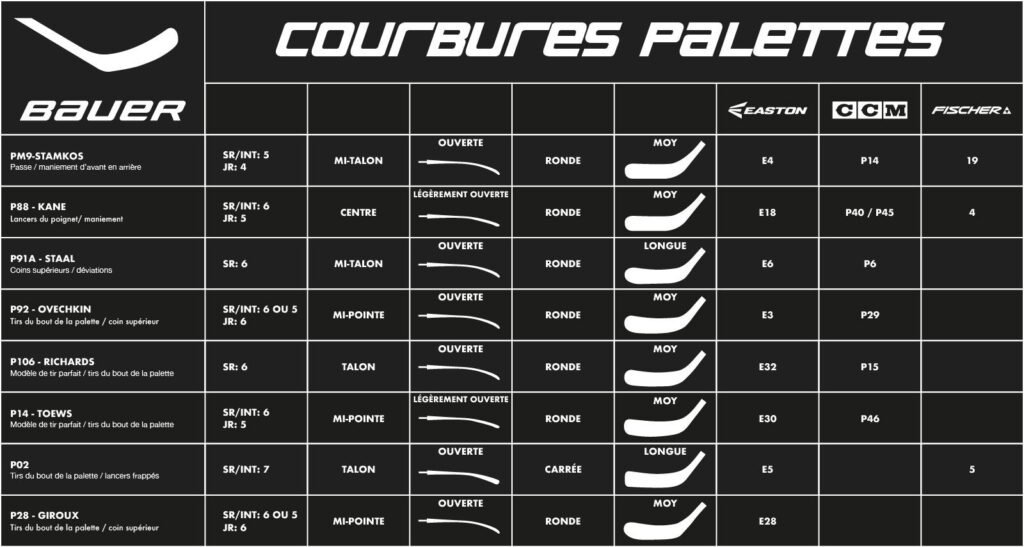
La curvature of the pallet affects the way you lift the puck, control the puck and aim. Each model of stick (Bauer, CCM, Warrior, True, Sherwood, etc.) has its own set of features.standard curves. Here are the most popular 👇
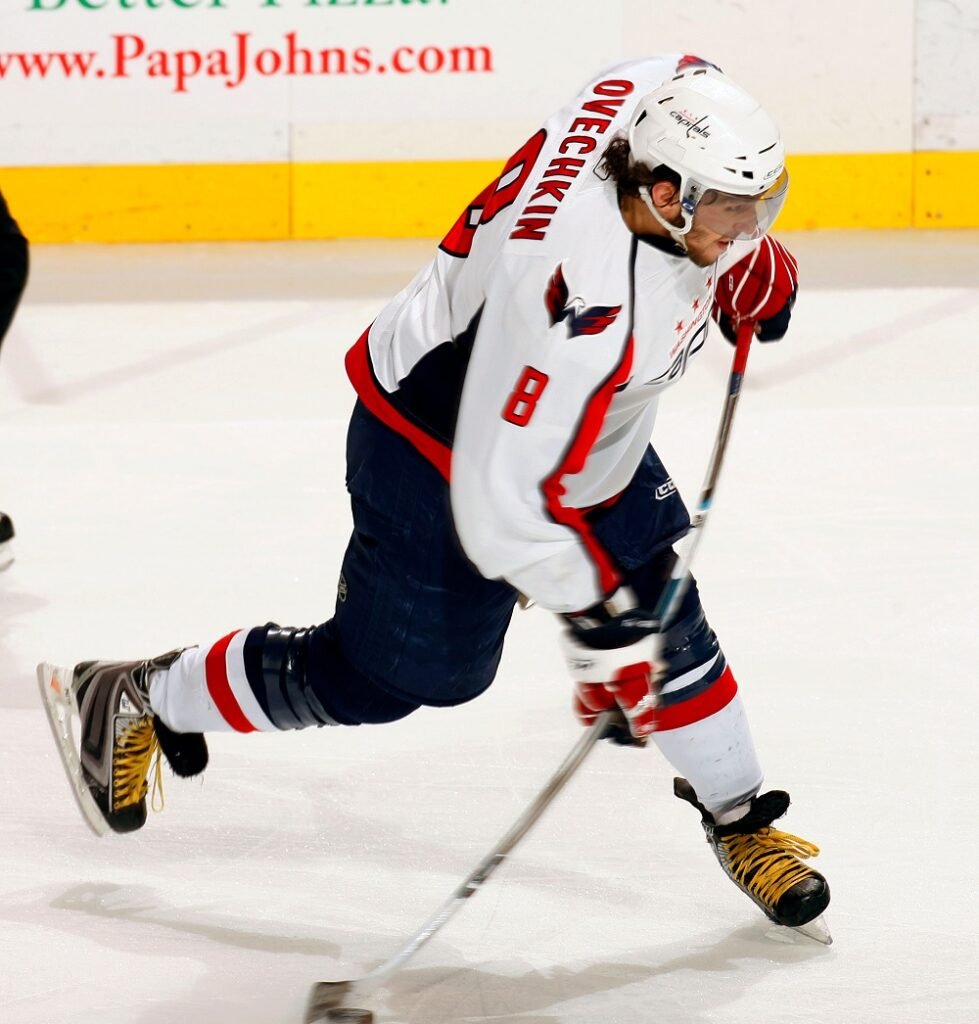
🔸 P92 (Ovechkin / Matthews Curve)
- Average curvature towards the end of the pallet.
- Excellent for pallet control and wrist shots.
- Very versatile, suitable for most styles.
- Ideal for technical, attacking players.
🔸 P28 (McDavid Curve)
- Accentuated curvature at the end of the pallet with a toe hook(final hook).
- Allows the puck to be lifted very easily, ideal for players looking for rapid angle shots.
- Less forgiving of long passes, but perfect for close play.
🔸 P88 (Kane Curve)
- Softer, more central curvature suitable for beginners.
- Excellent control for accurate passing and shooting.
🔸 P90TM (new generation hybrid)
- Mixture between P92 and P28: good control + rapid emergence.
- Very popular on the latest Bauer and CCM sticks.
💡Advice : if you're just starting out, choose a P92. It offers the best balance between manoeuvrability, precision and lift.
⚙️ 4. Materials: carbon, fibreglass, composite, etc.
The materials determine the lightness, strength and feel of your grip.
🧱 Wood
- Benefits: affordable price, classic feel, decent durability.
- Disadvantages: heavier, less responsive, deforms over time.
- Ideal for beginners or street hockey.
⚡ Composite (carbon, kevlar, fibreglass)
- Advantages: lightweight, better flexion, rapid energy transmission.
- Disadvantages: higher price, less durable than a wooden stock if used incorrectly.
- This is the current standard in modern hockey.
Top of the range stocks use 12K, 18K or 24K carbon with a monocoque technology for greater stability and power.
Professional models such as the Bauer Nexus Sync, CCM JetSpeed FT6 Pro or Warrior Covert QR5 Pro use highly reactive fibres to improve firing speed.
🧊 5. The kick point: the location of the bending point
Le kick point designates the area where the stick bends during the shot.
- Low kick (low flex) For fast shots (snaps, wrist shots). Ex: CCM Ribcor, Bauer Vapor.
- Mid kick For a more powerful but slower shot. Ex: Bauer Nexus, CCM Tacks.
- Hybrid kick Combines speed and power, ideal for all-rounders.
💡Example: A small striker will prefer a low kick, while a powerful defender will choose a mid kick to maximise slapshots.
🥅 6. The profile of the neck and the shape of the shaft
The handle influences your grip and comfort.
- Square shape (Traditional) More control, but less flexibility.
- Tapered shape for improved handling and smoother shooting.
- Grip The surface is slightly sticky to prevent the hand from slipping.
- Clear (without grip) The "hand": preferred by some for a freer glide of the hand.
💡 The choice of grip is staff Try both before deciding.
🧤 7. Adapting the stick to your style of play
| Style of play | Type of flex | Recommended curvature | Kick point |
|---|---|---|---|
| Technical striker | 70-80 | P28 or P92 | Low kick |
| Powerful defender | 90-100 | P88 or P90TM | Mid kick |
| Versatile | 80-85 | P92 or P90TM | Hybrid |
| Beginner | 65-75 | P88 | Mid kick |
🧽 8. Resistance and maintenance
To prolong the life of your stock:
- Avoid playing on abrasive surfaces (bitumen, concrete).
- Protect the bottom of the handle with adhesive tape.
- Don't leave your grip in the boot of your car in direct sunlight or in the cold.
- Regularly check that the pallet is not cracked or soft.
💡 Composite models perform very well, but are sensitive to poorly distributed impacts. Good maintenance can double their lifespan.
🏁 Conclusion
Choosing the right hockey stick is to find the perfect balance between power, control and comfort.
Take into account your weight, playing style, curvature and flexibility. Don't hesitate to try out several models before choosing the one that's right for you.
👉 About SportlandAmerican.com
🇬🇧 Version : English | 🇫🇷 Version française